
What Will Canada’s Arctic Investments Leave Behind?
Published June 30, 2026 | Hilltimes
As Canada increases its focus on the Arctic, the conversation has rightly centred on sovereignty, security, and defence. But for a country with more than half its coastline in the Arctic, long-term presence in the North depends on something just as fundamental: strong communities, thriving economies, and the industrial capacity required to sustain them. That reality should shape how we think about every investment that follows.
The urgency to strengthen Arctic security is real. But urgency should not come at the expense of intentionality. Over the next decade, Canada will invest billions of dollars in northern infrastructure, defence, critical technologies, and Arctic Ocean capability. These investments will strengthen our ability to operate in the North.
They also present a once-in-a-generation opportunity: to build the systems that enable long-term capacity in the North. The question is not simply what we build. It is what continues to be built because of it. Through Canada’s Ocean Supercluster’s work convening industry-led collaborations across the ocean economy, one lesson has emerged repeatedly: Projects create results. Connected projects create industries, and ultimately, the industrial capacity that underpins sovereignty and economic resilience.
Through projects delivered with Canadian ocean companies, from early-stage startups to scaling SMEs, we consistently see the same pattern. When a collaborative project model brings together industry-led consortia, SMEs, end users, research partners, Indigenous partners, and investors, technologies developed to solve one challenge find application in others. Commercial innovations become relevant to defence. In our portfolio, Canadian ocean companies are advancing capabilities in maritime domain awareness, subsea sensing, autonomous systems, secure communications, and real-time decision support, dual-use technologies that can improve commercial operations while strengthening Canada’s ability to understand, monitor, and operate in Arctic waters.
The value does not end with the technology. It compounds through the system that forms around it. Yet this is also where Canada too often loses momentum.
Through this work, it becomes clear that a successful pilot struggles to find its first operational customer. A promising technology never reaches procurement. A growing company cannot find the right partner, validation environment, or investment needed to scale. Across pilots, procurement, and commercialization, each transition introduces new actors, processes, and delays, often slowing or stalling progress altogether. For many SMEs, these gaps are not theoretical, they define whether a company can grow, compete, and contribute to Canada’s broader economic and industrial capacity. This is particularly true in sectors where Canadian companies are developing technologies proven in some of the world’s harshest and most remote environments, technologies with clear global market potential, but limited pathways to scale and reach international customers.
These challenges reflect a broader pattern of fragmentation across governments, industry, communities, and programs, often leading to duplication, consultation fatigue, and slow progress.
If Canada is serious about building long-term capacity in the Arctic, reducing this friction must become part of the strategy. This is not about adding fragmented programs. It is about connecting what already exists through more deliberate coordination, clearer pathways to procurement, and systems that support innovation all the way to deployment. Indigenous governments, development corporations, businesses, and knowledge holders are not stakeholders to be engaged once solutions are ready. They are partners in setting priorities, shaping solutions, building businesses, and strengthening regional supply chains. This is how investments translate into lasting economic resilience and the growth of northern capacity.
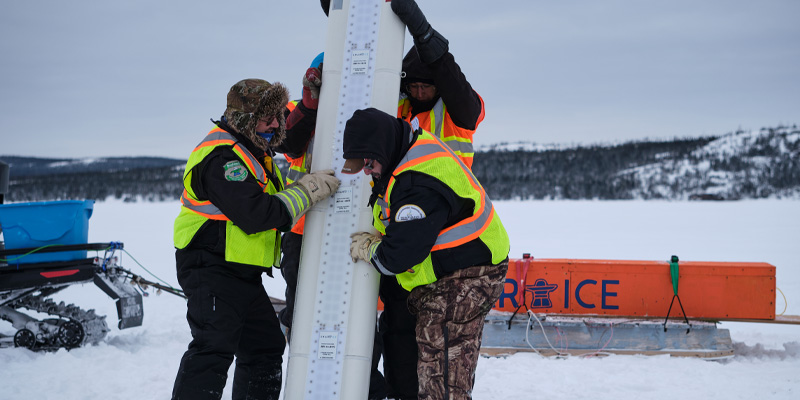
This approach reflects what we have seen work in practice, through examples such as the Indigenous Coastal Innovation Challenge where community-led models, combining Indigenous knowledge and technology, create more durable and scalable outcomes. Rather than relying on seasonal fly-in research teams, these models empower local communities to deploy local sensor networks and manage ocean data, ensuring that the critical capacity remains in the North long after the initial funding cycle ends. Where this does not occur, there is a growing risk that trust is eroded and Canada’s ability to advance shared Arctic priorities is weakened.
Through the work of Canada’s Ocean Supercluster’s Arctic Steering Committee and collaboration with a more than 1000-member network, there is a clear role here – not as another program layered onto the North, but as a platform for connecting Canadian ocean companies, Indigenous partners, end users, investors, researchers, and governments around shared Arctic priorities. Its value lies in helping projects move beyond isolated pilots toward deployment, procurement readiness, commercialization, and global market opportunity.
The same principle applies across the broader innovation ecosystem. Researchers, entrepreneurs, industry, governments, investors, end users, and communities all have roles to play. The challenge is not assembling these pieces. It is enabling them to function as a connected system rather than a series of disconnected transactions. In practice, this capability is rarely built by a single organization, it emerges through multiple SMEs, partners, and communities working together in coordinated ways. This is the core lesson collaborative innovation has taught us: Industrial capacity is not built one project at a time.
It is built by connecting projects into something larger than themselves. Individual projects can solve immediate challenges, but when Ocean Supercluster projects are connected across companies, end users, communities, and markets, they begin to build the industrial capacity Canada needs.
We should ask whether today’s investments make it easier for the next northern entrepreneur to grow a business, the next Indigenous partnership to scale, the next Canadian company to expand, and the next generation of firms to build on what came before.
Canada’s choices in the Arctic will leave a legacy. They can leave behind a collection of successful projects, or they can create an enduring foundation for northern prosperity, Indigenous economic leadership, stronger sovereignty, and globally competitive Canadian ocean industries. The difference will come down to whether we build for the North, or with the North, and whether we connect today’s investments to the capacity Canada will need tomorrow.