
September 17, 2026
FOR IMMEDIATE RELEASE
(WATERLOO, ON) – Today, Canada’s Ocean Supercluster announced two new ocean innovation projects valued at over $8 million, including the $4.7 million Ship Hull Inspection Platform (SHIP) Project led by Voyis Imaging.
This project delivers an innovative new solution that will modernize how vessel hull inspections are conducted, delivering faster, safer, and more accurate assessments for ship owners, ports, regulators, and maintenance teams. The SHIP project will replace traditional qualitative diver inspections with a quantitative, technology-driven workflow that combines autonomous marine robotics, advanced optical imaging, machine learning, and digital twin technology. Inspections include:
- Pier-side inspections during a berth window
- Three-dimensional hull twin & class-aware report
- Fewer diver entries & quicker maintenance decisions for improved port safety
The project also creates inclusive jobs within the Canadian supply chain, including in advanced engineering, manufacturing, and service jobs.
The project is led by Waterloo, ON-based Voyis Imaging in partnership with MarineNAV in Panmure Island, PEI. With a total project value of $4.7 million, Canada’s Ocean Supercluster is investing $2 million, with the balance of funding coming from project partners.
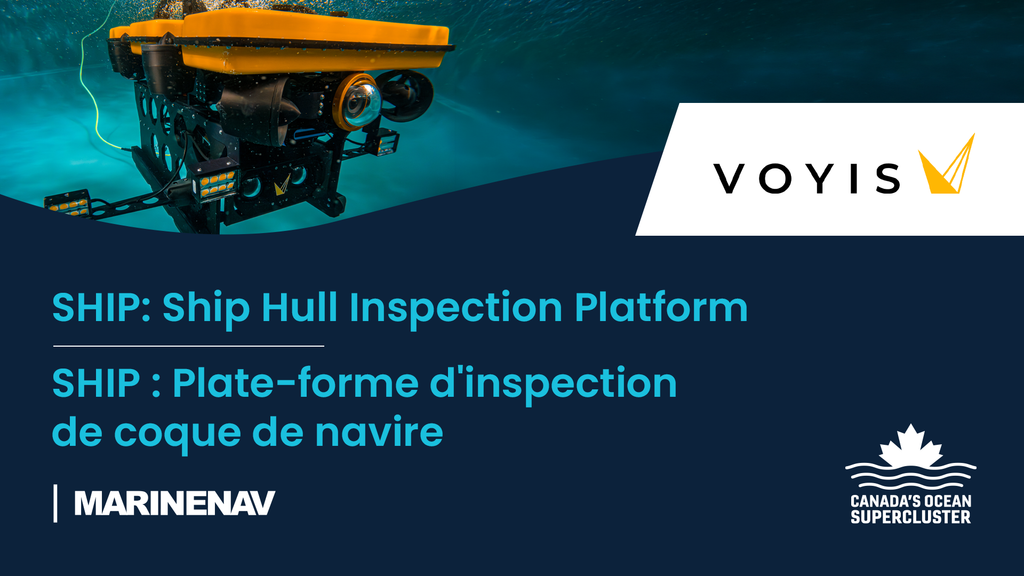
At the core of the system is a compact MarineNav remotely operated vehicle (ROV) equipped with Voyis optical sensors and software, enabling high-resolution inspection and three-dimensional reconstruction of vessel hulls while the ship remains in the water. The system generates a digital twin of the vessel hull, automatically identifying and documenting defects such as cracks, coating degradation, corrosion risks, and marine fouling. Inspection results are compiled into a clear report that can be immediately used by maintenance, compliance, and operations teams to support decision-making and reduce vessel downtime.
The project strengthens Canada’s ocean industrial capacity by advancing domestic expertise in autonomous marine systems, underwater imaging, machine learning, and digital twin technologies, while positioning Canada has a global leader in dual-use marine technology and contributing to the growth the ocean economy.
Through Ambition 2035 and together with Canada’s ocean community, we are bold in our ambition to grow Canada’s ocean economy 5X to $220 billion by 2035. Continued investment in the accelerated development and commercialization of globally relevant, made-in-Canada ocean solutions will help us realize this ambition. Read more about recommendations to help achieve this transformational growth opportunity outlined in Charting the Course to 5X Growth in Canada’s Ocean Economy and the projected benefits to Canada here.
-30-
Media Contacts
Nancy Andrews
Canada’s Ocean Supercluster
nancy.andrews@oceansupercluster.ca
About Canada’s Ocean Supercluster
Canada’s Ocean Supercluster accelerates the development and commercialization of made-in-Canada ocean solutions in blue food, arctic and security, Ocean Energy, and Marine Decarbonization, while also growing more companies, creating more jobs, and attracting ocean talent. As Canada’s national ocean cluster, the OSC is a convenor of members, partners, and networks and a catalyst for transformative growth that helps build the robust ecosystem needed to help realize Ambition 2035 – a 5X growth potential in ocean in Canada by 2035. To date, the OSC has approved 160 projects valued at more than $600 million, which will deliver more than 300 new made-in-Canada ocean products, processes, and services to sell to the world. Every dollar invested in Ocean Supercluster projects generates more than five times its value in GDP contribution, with the following economic benefits to Canada as of March 2025:
- $1.7 billion in total economic output
- $1 billion in GDP contribution
- ️Nearly $748 million in total labour income
- ️Close to 10,000 jobs created
- ️$286 million in total tax revenues generated
Quotes
“Supported by Canada’s Ocean Supercluster, one of Canada’s global innovation clusters, these projects aim to accelerate next-generation ocean technology breakthroughs. This is innovation with purpose: improving safety, advancing sustainable ocean industries and creating opportunities for Canadian companies to compete globally. With these investments, we are building a more resilient and prosperous future for coastal communities and for all Canadians.” – The Honourable Mélanie Joly, Minister of Industry and Minister responsible for Canada Economic Development for Quebec Regions
“AI is transforming how we understand and protect our oceans, and Canada intends to lead in this new era of AI‑powered ocean intelligence. By integrating AI with quantum photonics, robotics and underwater sensing, these projects will unlock powerful new capabilities. AI is a strategic asset for Canada’s ocean future, as this work strengthens our ability to respond to environmental, economic and security challenges.” – The Honourable Evan Solomon, Minister of Artificial Intelligence and Digital Innovation and Minister responsible for the Federal Economic Development Agency for Southern Ontario
“The SHIP project advances Canada’s capabilities in marine robotics, underwater sensing, and artificial intelligence while delivering safer and more cost-effective vessel inspections. The project will support skilled jobs, generate recurring service revenues, and strengthen supply chains across manufacturing, technology, and marine operations. As demand grows worldwide for smarter, data-driven maintenance solutions, SHIP positions Canada to capture new export opportunities for Canadian SMEs.” – Kendra MacDonald, CEO, Canada’s Ocean Supercluster
“SHIP represents an important step forward in how we approach underwater vessel inspections. By combining high-resolution optical imaging, 3D reconstruction, and intelligent data processing on a compact ROV platform, we can turn an inspection from a largely qualitative assessment into a detailed, measurable digital record of the hull. This gives operators the information they need to identify issues earlier, make better maintenance decisions, and ultimately reduce the time and risk associated with keeping vessels in service.” – Adam Riese, VP of Engineering, Voyis Imaging