It was my first CANSEC, and Ottawa is buzzing with opportunity.
There is a real sense of momentum around Canada’s defence sector right now. From the Defence Industrial Strategy, the Defence Innovation Hub, the Defence Innovation Secure Hubs (DISH), to the Defence Investment Agency (DIA), the Defence Security and Resilience Bank (DSRB), and Industrial and Technological Benefits (ITBs), there is significant focus on building Canada’s defence and innovation capacity.
The promise is incredible.
Walking the floor, the energy was unmistakable. A record number of companies are here, from established primes to emerging SMEs, all looking to understand where they fit in the future of Canada’s defence economy.
What stood out most to me was how many Canada’s Ocean Supercluster (OSC) companies and projects were represented across the event. It was exciting to see ocean companies demonstrating capabilities that are increasingly relevant not only to ocean industries, but also to defence and security applications.
More importantly, many of these companies already have the capabilities the Department of National Defence is looking for. The innovation exists. The talent exists. The technology exists.
At the same time, procurement modernization continues to be one of the central challenges and conversations across the sector. There is recognition that meaningful work is underway to improve how innovation moves from Canadian companies into adoption and operational capability, but there is also urgency around ensuring execution keeps pace with the ambition.
Execution was probably the word I heard most consistently throughout the event.
There is no shortage of frameworks, strategies, funding announcements, or spending commitments. The conversation is increasingly shifting from investment commitments to delivery and operational capability and how these efforts translate into economic growth, sovereign capability, and long-term industrial transformation for Canada.
One of the most interesting trends emerging is the increase in organizations acting as “matchmakers” between large defence companies and SMEs. These organizations are helping smaller companies navigate how to work with primes and government procurement systems, while also helping primes identify the right capabilities and technologies within Canada’s innovation ecosystem.
That role matters.
Canada has extraordinary small and medium-sized companies, but entering the defence sector and navigating procurement pathways can be challenging, particularly for companies participating for the first time. Building stronger pathways between innovators, primes, and government may prove just as important as the technologies themselves.
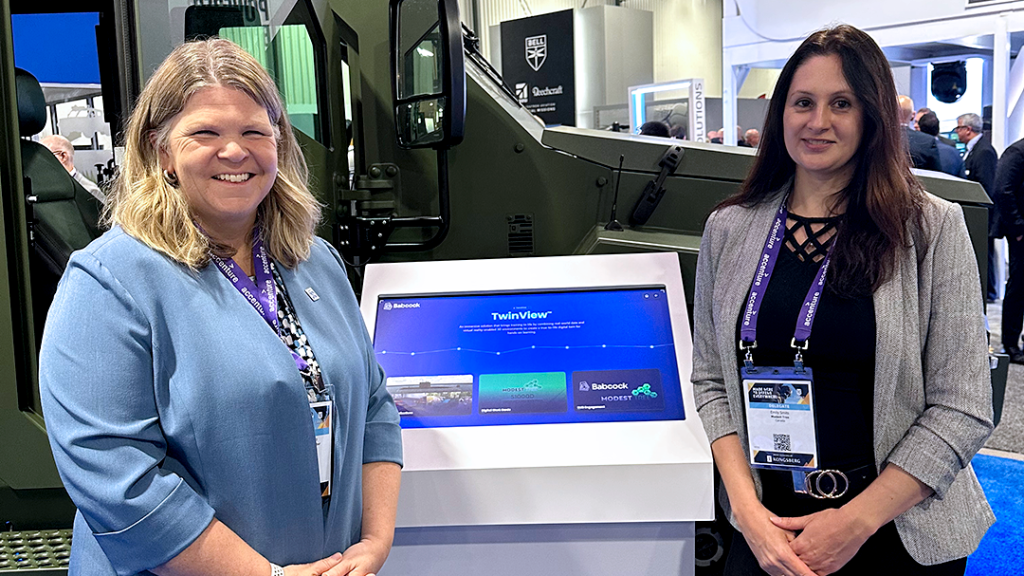
I also had the opportunity to see a demonstration of Modest Tree’s Tech Companion, an OSC-supported project integrated into a broader suite of services with Babcock. It was a strong example of how Canadian companies are developing practical, deployable solutions that improve training, operational readiness, and workforce capability. More importantly, it demonstrated what becomes possible when SMEs and large organizations work together effectively.
CANSEC also reinforced that this is no longer only a domestic conversation.
There were delegations from Germany, Poland, Singapore, Denmark, the Philippines, and many other countries, all looking to build partnerships and identify opportunities for collaboration. Countries are increasingly focused on building sovereign capabilities that can also scale into export opportunities, and Canada is part of that broader global shift.
“If we want Canadian companies to grow, we need to continue creating pathways into international markets and strengthening opportunities for collaboration globally.”
– Kendra MacDonald
If we want Canadian companies to grow, we need to continue creating pathways into international markets and strengthening opportunities for collaboration globally.
At the same time, it is important to remember why there is such an increased focus on defence spending globally. For much of my lifetime, the world felt relatively stable. The assumptions that shaped globalization over the last several decades are evolving quickly. Global relationships are becoming more complex, where countries can be partners one day and competitors the next.
Governments around the world are reassessing economic security, supply chains, defence readiness, technological sovereignty, and resilience in response to a rapidly changing geopolitical environment.
That reality is creating urgency, but also opportunity.
As an ocean nation with the world’s longest coastline, Canada’s future conversations around defence, resilience, sovereignty, and security will increasingly intersect with ocean technologies and capabilities. Many technologies developed for ocean industries are increasingly being recognized as dual-use capabilities: commercial innovations with defence and security applications. For Canada’s ocean economy, this creates an important moment to demonstrate how ocean capabilities can contribute to broader national priorities, including Arctic security, maritime awareness, critical infrastructure, and resilient supply chains.
CANSEC reinforced that Canada has the companies, technologies, and talent to play a much larger role in the future of defence innovation. The momentum is real. Now comes the important part: execution.
By: Kendra MacDonald, CEO, Canada’s Ocean Supercluster