
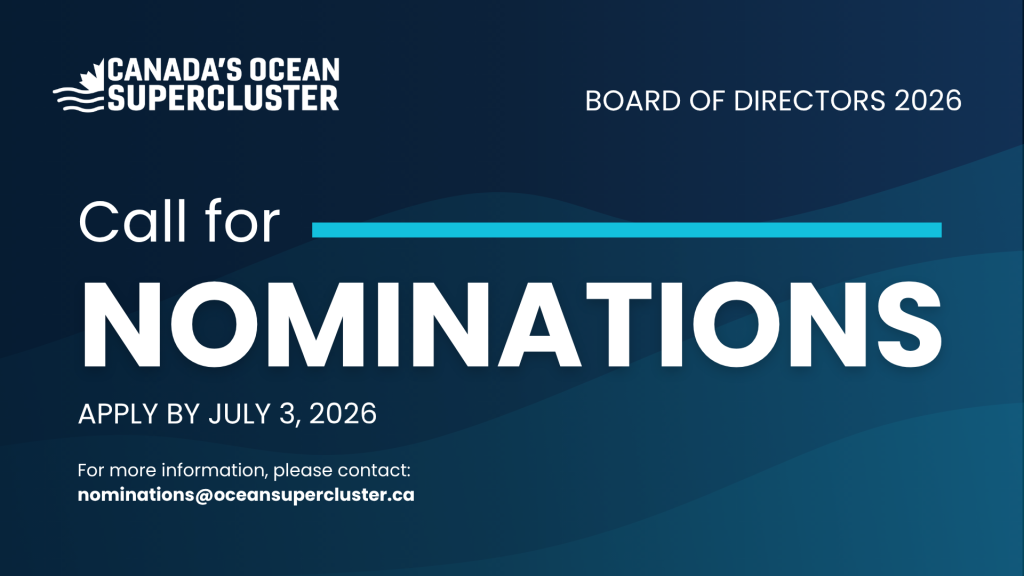
Opportunity for Financial Leader to Join Canada’s Ocean Supercluster Board of Directors
June 1, 2026
Are you a finance leader with a professional accounting designation who is passionate about helping grow Canada’s ocean economy? Are you interested in supporting solutions that tackle major challenges including decarbonization, food security, emissions reductions, and biodiversity loss through strategic, industry-led innovation? Are you able to bring strong financial oversight and risk-informed judgment to a national organization managing public and private investment? Then now is the time to consider a seat on the Board of Canada’s Ocean Supercluster (OSC).
Canada’s Ocean Supercluster is one of the world’s largest ocean clusters with more than 1000 members from coast-to-coast-to-coast focused on the commercialization of made-in-Canada ocean innovation and building a robust innovation ecosystem to support the transformational growth potential ahead. OSC has a portfolio of more than 160 projects with a total value of $600 million and focuses its investments and activity on Blue Foods, Maritime Awareness and Dual Use Solutions, Decarbonization of Marine Transport, Energy and Climate Solutions.
So, what are you signing up for if you put your name forward for the OSC Board?
OSC’s Board of Directors is comprised of seasoned leaders who draw on diverse experience and background to provide strategic direction and oversight. At a high level, the Board helps guide the pan-Canadian deployment of industry and Government funding, oversees organizational planning and risk management, and ensures the organization fulfills its legal obligations.
Virtual Board meetings are held between 6 and 10 times per year, with 1–2 in-person meetings annually. Overall, the time commitment is estimated at 3–4 hours per month, which may increase with committee involvement. This is a volunteer role; approved travel costs for in-person meetings are reimbursed in accordance with policy.
What we are looking for
OSC is seeking a Board candidate who brings strong financial literacy and audit/assurance capability, to assist the Board in fulfilling its obligations and oversight responsibilities in relation to financial reporting, financial planning and investments, the external audit process, monitoring compliance with the financial conditions of the Contribution Agreement (“CA”), the systems of internal control and risk management.
Required qualifications
- Professional accounting designation (e.g., CPA or equivalent).
- Demonstrated senior-level experience providing strategic financial oversight, ideally in complex, stakeholder-facing environments (e.g., Government funding, regulated sectors, multi-entity organizations).
Willingness and ability to serve on the Audit Committee, including supporting oversight of audited financial statements, internal controls, financial risk, and audit planning.
Diversity, independence, and Board composition considerations
OSC welcomes nominees from diverse backgrounds and is committed to Diversity, Equity and Inclusion (DEI), including commitments aligned with Canada’s 50–30 Challenge. In assessing candidates, independence, gender, and self-identification as a visible minority will be taken into consideration as part of building a strong, competency-based Board.
OSC also considers Independent Director status (as defined for OSC governance requirements). A “yes” answer to independence screening questions does not disqualify a candidate, but supports OSC in meeting its Independent Director composition requirements.
How to apply
If you are interested in joining the OSC Board of Directors, please submit:
- a completed Nomination Form, and
- your CV combined into one PDF, to nominations@oceansupercluster.ca by July 3.
Canada’s Ocean Supercluster RFP: Ocean Industry Funding Landscape Study
May 21, 2026
Canada’s Ocean Supercluster (OSC) has issued a new Request for Proposals (RFP) to conduct a comprehensive Ocean Industry Funding Landscape Research Study, aiming to better understand and address the persistent access‑to‑capital challenges facing Canada’s ocean economy.
The RFP notes that while global ocean industries continue to grow rapidly, “access to capital is the single-biggest challenge facing the growth of Canada’s ocean sector” and that the issue varies significantly by sub‑sector, company size, region, and type of capital. The study will identify critical gaps from the perspective of both funders and ocean companies, as well as produce a comprehensive, evidence-based map of the funding ecosystem as it exists today, and outline learnings for Canada based on leading practices in capital deployment in other economies.
Scope of the Study
The study will be conducted in a phased approach, with Phase 1 of the project focused on three priority sub‑sectors:
- Aquaculture
- Marine decarbonization
- Marine domain awareness (including sensors, platforms, UAVs, and telemetry‑based data products)
Phase 1 will also examine challenges by Stage (pre-seed/seed, to commercialization stage, to scale-up stage), funder type (including catalytic funds traditional funders, angel investors, VCs, private equity, and government), and capital stack (non-dilutive, different forms of equity, debt, and structured finance).
Key deliverables include:
- A Critical Market Gaps Analysis
- A Current State of Funding in the Canadian ocean sector
- Optional global comparisons and leading practices
- A final report and presentation suitable for broad stakeholder engagement
The project is expected to run from June to August 2026, with a maximum budget of $150,000 CAD.
Proposal Requirements
Applicants must outline their methodology, team experience, budget breakdown, and any areas where OSC support may be required (e.g., introductions to companies). The RFP emphasizes that respondents should demonstrate strong connectivity to relevant funder groups and experience in ocean-sector or capital‑market analysis.
Submission Deadline & Contact
Proposals are due Friday, June 12, 2026 at 11:59 p.m. ADT.
Submissions and questions should be directed to:
Jakub Skrzypczyk
Canada’s Ocean Supercluster
Jakub.Skrzypczyk@oceansupercluster.ca
Market Solutions Platform: Developing the Market Conditions for Ocean-Based Climate solutions to Scale
Current Challenge:
Ocean-based climate solutions are a critical enabler of Canada’s transition to a low-carbon economy, climate competitiveness, and economic growth agenda. This specifically includes marine decarbonization and marine carbon dioxide removal (mCDR) for climate mitigation.
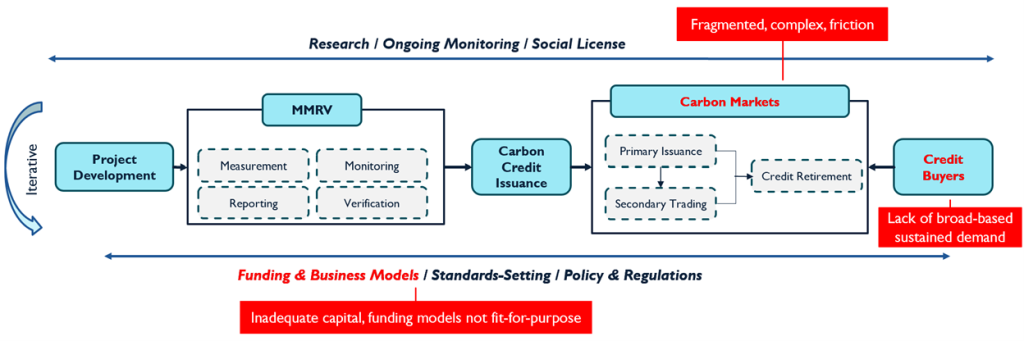
However, ocean-based climate solutions are value-chain based and will only be as strong as the weakest link. While significant efforts are currently underway across scientific research, technology development, policy advancement, and community engagement related components, they are not enough to make these solutions economically viable or scalable. Using carbon removal as an example: not only is there not enough funding being deployed, one can argue that the funding structures are not fit for purpose either. There is a lack of broad-based and sustained demand for the outputs of removal solutions, and carbon markets continue to remain a complex, fragmented, and difficult pathway for commercialization.
Market Solutions Platform:
It is imperative that these business-related components of the value chain are advanced in parallel, which is a crucial gap across the sector. Market Solutions Platform (MSP), a new strategic initiative of Canada’s Ocean Supercluster, is aimed at addressing this gap by accelerating the development of market for ocean-based climate solutions.
The outputs from MSP will be a portfolio of solution-enablement assets and will vary by the nature of the problem being addressed. Examples include proof of concepts, funding constructs, case studies, leading practices, or applied frontier research.
Ecosystem-based:
A fundamental design element of MSP is an ecosystem-based approach that leverages a network-of-network model. Efforts and direction of MSP will be guided and informed by the insights and expertise of a Strategic Advisory Team that is comprised of senior climate-business leaders with expertise in finance, capital markets, and carbon management, as well as our institutional collaboration partners CIBC, S2G Investments, Katapult Ocean, Propeller Ventures, and The Sustainability Accelerator, based in the Stanford Doerr School of Sustainability.
There are many opportunities to engage and collaborate with Canada’s Ocean Supercluster on MSP. If you want to learn more, then please visit https://oceansupercluster.ca/msp/ or contact msp@oceansupercluster.ca.
By: Akash Rastogi, Chief Capital Strategy Officer, Canada’s Ocean Supercluster
World Water Day: An Indigenous Perspective
A message is given that the time to grow, compete, and lead on the global stage is now. Canada needs future-shaping industries with bold ambition to carry growth forward.
March 22nd is World Water Day. A day to reflect on the importance of water. A challenge for humans today on a global stage is the growing awareness of the need for the caring of the earth, water, and repair of the environmental damage.
The spring equinox just occurred on March 20th. The spring equinox was the official new year for many global cultures around the world, including the Algonkian tribes in the northeast of Turtle Island (North America today). It is a day of balance, whereby, with the line up of the sun and moon, there is an equal amount of daylight and darkness. The return of the longer light of the sun to make things grow.
The moon controls the waters, including the tides. It represents the female water teachings connected to the carrying of water in the womb that brings new life. The sun is fire energy, which is represented by the male. In the culture, women are considered the “keepers of the waters” and men the “keepers of the fire.” The contrast is important in bringing in and sustaining new life. Similar to the sun and moon cycles impacting the Earth.
To many Indigenous nations, the earth is considered a living entity, and instructions were given in the caretaking of the land and its richness through oral history. Today, this is known as traditional knowledge. An example of this understanding is that the rivers and streams were seen as the veins of earth, like the human body. The human body is made up of about 70 percent water. Interestingly, about 71 percent of the earth’s surface is also water covered. The oceans hold about 96.5 percent of all Earth’s water, leaving only 3.5% freshwater globally. Utmost care is needed in preserving this resource.
The ancestors foretold that humans will be at a crossroads in the caretaking of the earth. That water would someday be for sale and not everyone will have a right to safe water.
As the Elders would remind the people in gatherings in the past: “We are here for future generations and it is not only human nations but also the animal nations, the winged nations, the ones that swim nations, the plant nations, the minerals, etc.”
With the need for industry to grow, compete, and lead on the global stage, we need to include the rising challenge of reparation and preservation of water for earth’s balance with this growth. A challenge to be seen not as a burden but an opportunity for innovative growth.
By: Elder Verna McGregor, Kitigan Zibi Anishinabeg First Nation
The Marine Dual-use Innovation Opportunity
If you can prove your tech works in real marine operations, you have a foundation for a global business.
The ocean is harsh. That’s why marine innovation can move into defence faster
Canada is a maritime nation bordered by three oceans and shaped by long coastlines, busy ports, and Northern waters that demand competence, not hype.
I started my career as a Naval Engineering Officer in the Royal Canadian Navy and later became an entrepreneur. Those two worlds taught me the same lesson: the marine environment is unforgiving, and it quickly shows you what’s real. Salt, cold, corrosion, vibration, and intermittent connectivity pose significant challenges to innovation, so if your technology works both offshore and on the waterfront, you’ve already passed a test most sectors never face.
That’s why many ocean-tech companies are closer to defence relevance than they think. And because marine operations generate huge volumes of sensor and operational data, AI is moving from a nice-to-have to an operational advantage.
Why this matters now for Canada
Canada’s new Defence Industrial Strategy makes one thing clear: national security and sovereignty aren’t just about what we buy, they’re about the strength of Canadian companies that can design, build, and maintain capability over decades.
From an OSC perspective, this is a meaningful opportunity for the ocean sector. By proving our technology at home, we’re not only serving domestic needs, but we’re also building strong foundations for Canadian marine products and services to compete in allied markets where reliability matters more than hype. If you have traction in the commercial marine space, you already have one of the most credible “business cards” in the world.
“Ocean-ready” is more than a slogan
Defence doesn’t just need clever ideas; it needs gear that won’t quit when conditions become tough. Defence needs systems that are:
- Reliable: systems that keep working in harsh conditions and still perform after months of real operations, not just during a controlled demo.
- Sustainable: tools that can be maintained with practical spares, documentation, and trained hands, so they can be deployed repeatedly at scale, especially in remote and harsh environments.
- Secure & interoperable: It must work with other systems and stay protected against cyber threats.
- Scalable: It needs to graduate from a “one-off success” to something we can roll out reliably, and repeatedly, without reinventing the system each time.
In plain terms: the marine environment is a built-in stress test. If you’re selling to ports, subsea companies, or coastal monitoring, you’re already being measured against these realities. Marine customers have near-zero tolerance for downtime, which is a mindset that translates well to national security.
AI at the edge: because the middle of the ocean has no cloud
We’re drowning in data but starving for insight. Modern maritime operations generate massive amounts of data, including radar, AIS, imagery, acoustics, telemetry, weather, and more. The challenge isn’t a lack of data, but how quickly we can interpret that data to assess what is happening.
In a high-stakes environment, an operator doesn’t need a raw data dump, they need a prioritized picture and confidence they can act on. This is where AI fits. Across the OSC ecosystem, we are seeing AI move to the edge, meaning it’s running directly on the ship or buoy rather than waiting for a satellite link to a server on land.
That “data-to-decision” speed is critical. Whether you’re optimizing commercial operations or maintaining awareness of unidentified activity in remote waters, the goal is the same: move from raw data to confident action before the window closes. In defence contexts, that speed must come with clear human oversight, traceability, and secure data handling.
The barrier: technology versus translation
The question now is: why don’t we see more ocean innovation quickly flowing into defence? It’s because “dual-use” isn’t just a label; it’s a translation job.
Marine innovators often hit the same walls:
- The language: requirements, compliance, and risk frameworks can feel like a foreign dialect.
- The timeline: defence procurement cycles can be longer than commercial cycles, so you need a plan that keeps revenue moving while you qualify.
- The trust gap: defence will ask where your data came from, how your models behave in mission-critical edge cases, and how humans remain in control.
None of these are insurmountable, but they can be hard to navigate alone, especially for SMEs with limited resources. It’s possible to board a moving ship in a swell, but it’s much easier with pilotage.
Sovereignty is about people, not just geography
If Canada is serious about sovereignty “coast to coast to coast,” then Indigenous and Inuit participation needs to be treated as foundational and not an afterthought.
Canada’s defence direction emphasizes stronger partnerships in the North. In practice, this means building programs that respect community priorities and create local capacity. A system is only truly “defence-ready” if the people living in the region are part of the leadership, the training, and the long-term support model. That means creating practical pathways to training, employment, local operations roles, and durable support capacity.
How OSC can help
OSC’s role is to help Canada’s ocean innovators prosper. For companies that decide defence is a sector they would like to explore, OSC will continue to develop programming and pathways that make that exploration more practical and more likely to succeed, without losing sight of commercial realities.
OSC’s support can include ecosystem orientation, translation support, and connection to partners who can help with validation, integration, and scaling. This includes ensuring Indigenous and Inuit partners help shape the solutions and bring local knowledge into how systems are designed, tested, deployed, and supported coast to coast to coast.
If defence is on your horizon, don’t wait for a perfect RFP. Document your “salt-water proof,” identify your top readiness gaps (security, integration, supportability), and be ready to engage. OSC will continue to develop programming to help members translate commercial traction into defence relevance and help connections with partners who can validate and scale.
By: James Craig, Chief Development Officer, Canada’s Ocean Supercluster
AI and Quantum at Sea: Canada’s Ocean Opportunity
I recently explored why ocean observation underpins a strong ocean economy. With advances from seabed mapping to real time sensors, we’re seeing the ocean in ways that were unimaginable a few years ago. But observation is only the start. AI and quantum technologies are reshaping decision‑making at sea, and this is Canada’s moment to lead.
The Ocean as a Living Data Layer
Our ocean is becoming increasingly digitized. Sensors are now deployed on vessels, autonomous drones, buoys, and underwater platforms. Low-cost satellites are multiplying the scale and fidelity of Earth observation. For the first time, we’re generating meaningful ocean data at a scale that AI systems can use.
Historically, lack of usable data has been one of the biggest barriers to applying AI in the ocean. Now the challenge is how we structure, share, and act on that data, particularly in real time, in extreme conditions, and across jurisdictions.
From Algorithms to Action: AI in Ocean Applications
AI in ocean isn’t just about building a good model. It’s about sustaining intelligent systems in remote, disconnected, and unpredictable environments. What does that unlock?
- Smarter weather prediction to improve safety and operations, from ship routing to offshore wind optimization.
- Autonomous inspection of vessels, subsea cables, and offshore platforms using drones paired with agentic AI.
- Adaptive digital twins that update with real time data to forecast biodiversity shifts, support stock assessments, and guide infrastructure planning.
- Smarter resource management, from monitoring protected areas and detecting illegal fishing to enabling selective gear that reduces bycatch.
We’ve also seen tangible commercial results. ThisFish, an early Ocean Supercluster investment, has boosted efficiency in fish processing through automated quality inspection, proving AI can drive both sustainability and profitability. As well, OnDeck AI, once a $10,000 Ocean Idea Challenge winner, is now emerging as a leader in marine object identification for defence, showing how small AI bets can scale into major outcomes with the right ecosystem.
Ocean Expert Knowledge Important for AI Founders
Building AI for the ocean isn’t like building for fintech or e‑commerce. The ocean is open, unpredictable, and interconnected; it ignores borders and bandwidth limits. To accelerate ocean intelligence, we need to design with those realities in mind.
Some things AI innovators should consider:
- The ocean moves in seasons. Missing a weather window can delay your testing by a year. Seasonality affects everything from data collection to validation and deployment.
- You’re operating in a contested, regulated space. From Indigenous data sovereignty to international maritime law, AI tools need to be designed with permission, security, and compliance in mind.
- Context matters. A model trained in the Pacific might underperform in the Arctic. AI systems must adapt to local conditions and evolving baselines.
- Many ocean tech projects still stall between research and real-world deployment. There is still work to do to develop paths from pilot to product, including investments in market validation, procurement pathways, and deployment infrastructure.
- Collaboration: success in ocean AI means working across sectors, engineers, Indigenous leaders, regulators, and researchers. Building trust across these communities is just as important as technical performance.
- Designing with AI ethics at the core: respecting data sovereignty, minimizing environmental impact, and ensuring autonomous systems act responsibly. Ethics also means inclusion: rural, remote, and Indigenous communities must have the tools, training, and insights to benefit from ocean innovation, not just experience its effects.
AI Ocean Projects to Watch
Canada’s Ocean Supercluster has co-funded over 150 projects, half of which now feature AI.
- Forecast AI: A $4.5M project led by MarineLabs to deliver hyper-local marine weather forecasts using AI, improving safety and operational planning for maritime operators.
- Oceanic Digital Twin Maritime Autonomy: A $6M initiative blending digital twins with autonomous maritime systems to increase efficiency, develop predictive maintenance algorithms and support next-generation communications frameworks.
- Enhanced Aquaculture Health Monitoring: A $5.9M AI-driven initiative to track fish health in real time and reduce stock losses, helping future-proof global food supply.
- Maritime Emergency Response System (MERS): A $1.4M AI system to enhance Canada’s ability to respond to maritime incidents with real time data and decision support.
- Environmental Genomics for Aquaculture: A $2.9M project leveraging AI to interpret eDNA for improved pathogen detection and environmental performance in salmon aquaculture.
- Smart Hook: A $4M project to build an autonomous recovery system for underwater assets, merging robotics and AI to tackle one of ocean tech’s most operationally difficult problems.
These are commercial-scale projects built with partners, co-investment from industry, and global applicability.
The Quantum Multiplier
Quantum computing could dramatically accelerate what’s possible (see the Canadian National Quantum Strategy). Optimizing marine logistics, simulating ocean-climate interactions, managing high-volume sensor data – these are computationally intensive problems that could be ideally suited to quantum computing as capabilities mature.
Combine quantum with autonomous systems and real time analytics, and we move from reactive to predictive ocean intelligence.
Canada’s Moment: A Leadership Opportunity in Ocean Intelligence
Canada has the world’s longest coastline, vast ocean territory, and strong AI and quantum ecosystems, but these strengths are still too often siloed. Ocean innovators rarely connect with quantum labs, AI founders don’t know the ocean’s urgent challenges, and investors haven’t yet recognized the ocean economy as a major data and intelligence frontier.
It’s also a key moment for dual‑use ocean technologies, where civilian, environmental, and defense needs converge in areas like surveillance, maritime awareness, and autonomous systems. Canada’s reputation for trusted, secure, and resilient tech gives it an edge.
The task now is to build the bridges, linking people, platforms, and capital, so Canada doesn’t just participate in this convergence but helps lead it globally.
A Call to Investors: This Is the Next Frontier
Canada has a generational opportunity to lead in ocean intelligence. With world‑class AI and quantum talent, rapidly expanding ocean datasets, and one of the planet’s most complex marine environments, including an Arctic coastline that spans nearly half the country, we’re positioned to turn this advantage into a global export.
But we need to move quickly and responsibly. For AI and deep‑tech investors, the next frontier isn’t land or space, it’s the ocean.
By: Kendra MacDonald, Chief Executive Officer, Canada’s Ocean Supercluster
mCDR: A Potential Billion Dollar Asset for Canada’s Climate Competitiveness
The ocean plays a central role in regulating the climate globally. It is the largest carbon storage sink on Earth, stores 45 times more carbon than the atmosphere, and 20 times more than land plants and soil combined. The ocean has already absorbed 40 per cent of fossil fuel emissions and 90 per cent of excess heat, and is continuing to absorb 30 per cent of excess carbon dioxide emissions annually.
This is what marine carbon dioxide removal (mCDR) entails. It is a suite of methods that either amplify or accelerate the ocean’s natural processes – be it biological, physical, or chemical, to reduce carbon in the atmosphere and safely store it in the ocean. Examples of mCDR approaches include ocean alkalinity enhancement, iron fertilization, artificial downwelling and upwelling, and electrochemical techniques.
It won’t come as a surprise that Canada – with the largest coastline in the world, a deep pedigree in ocean science, research, and technology development, mature marine infrastructure, and a vibrant innovation ecosystem – is well positioned to harness the potential of mCDR. But what is the opportunity? That is the question that a recent study led by Canada’s Ocean Supercluster and co-funded by a consortium of organizations across Canada, answers.
The opportunity comes from two levers: climate change mitigation and economic growth.
Climate Change Mitigation
The study estimates that mCDR has the potential to remove 130 metric tons of carbon from the atmosphere per year by 2050. To put this number into context, it represents about 15 per cent of Canada’s current carbon emissions, and 40 per cent of durable carbon removal capacity that Canada will need to be in line with the Paris Agreement’s 1.5-degree goal. In addition, if removals are allowed to be included in Nationally Determined Contributions (NDCs) – that is, commitments made by Canada to reduce greenhouse gas emissions – then mCDR can significantly help Canada meet those commitments. Beyond emission reductions, some mCDR approaches could also help Canada realize other benefits, such as reduction in acidification of its oceans, protecting marine habitats, and supporting coastal resiliency.
Thus, mCDR can significantly help Canada with its climate mitigation goals by reducing net emissions, developing scaled carbon removal capacity, meeting its international climate commitments, and significantly aiding Canada’s transition to a low carbon economy.
Economic Growth
mCDR also offers a meaningful contribution to Canada’s economic growth prospects via job creation, GDP growth, capital investment, and transitioning of workforce. The study estimates that by 2050 mCDR could:
- Create 90,000 new direct permanent jobs across Canada, with indirect job creation likely double of that – this amounts to about a third of Canada’s current total employment in the cleantech sector;
- Increase Canada’s GDP by $16B – about a third of Canada’s current ocean economy;
- Attract upwards of $30B of domestic and foreign capital investment; and
- Contribute to the creation of new investment and export opportunities.
To put the economic projections of mCDR into perspective, Canada’s electricity utility sector currently employs approximately 100,000 people throughout Canada, attracts more than $22 billion in capital investment, and contributes $35 billion to Canada’s GDP – numbers similar to mCDR projections for 2050. Thus, the mCDR sector in Canada in 2050 could be as big as the electricity utility sector is today.
In short, mCDR is not only well-aligned for Canada, but can also significantly contribute to Canada’s strategic objectives of climate competitiveness, transition to a low carbon economy, and economic growth, and should be actively nurtured in a responsible and equitable manner.
mCDR is still in its nascent stage and requires catalytic action from government, private sector, and communities to transform Canada’s starting advantage to be a global leader in mCDR into a lasting advantage.
By: Akash Rastogi, Chief Capital Strategy Officer, Canada’s Ocean Supercluster
Canada’s Ocean Economy: A National Asset Driving Growth and Innovation
Last week in Ottawa, during Ocean Week on the Hill, Canada’s Ocean Supercluster’s Board and Senior Leaders met with more than 50 officials from across eight different departments with the message that Canada’s ocean economy is building tremendous momentum with the opportunity to achieve a bold, 5X growth Ambition by 2035. With a membership of almost 1,000 from across the country, we spoke of the cluster and the broader Canadian ocean network as a national asset and framework from which we can work together to help deliver on Government’s key priorities.
Turning Investment into Impact
Since its inception, the OSC has been advancing a vision of a digital, sustainable, and globally competitive ocean economy. With just over $200 million in OSC ocean innovation project investments to March 2025, the cluster has co-invested alongside industry in close to 150 collaborative projects and has ultimately accelerated the development of more than 300 new ocean products and processes to sell to the world.
A recent economic report by Mansfield Consulting highlights the impact of OSC’s activities and investment with industry to March 2025. The study found that every dollar invested through the Ocean Supercluster generates more than five times its value in GDP contribution, underscoring the long-term economic and societal benefits of building a world-class ocean innovation ecosystem.
Delivering Economic Growth Across Canada
The economic impacts of OSC’s work to March 2025 includes:
- $1.7 billion in total economic output
- $1 billion in GDP contribution
- Nearly $748 million in total labour income
- Close to 10,000 jobs created
- $286 million in total tax revenues generated
- $295 million in follow-on investment raised
These numbers reflect more than financial returns; they represent new companies formed, new technologies brought to market, and a growing community of innovators creating sustainable prosperity through ocean opportunities. Through work of the OSC, 200 new ocean companies have been created, and 85 million people have learned more about the significance of the ocean economy through marketing campaigns.
Canada’s Ocean Moment
As Canada focuses on diversification of global partnerships, expanded market opportunities for made in Canada products and services, increased focus on defence and dual use opportunities, climate adaptation and resiliency, and meeting the moment in the transition of energy, food security, arctic activity and building a stronger economy and thriving communities for the future, we know this moment is also Canada’s ocean moment.
As the Government of Canada prepares to deliver strategies focused on AI, industrial defence, trade diversification, and climate competitiveness in the months to come, it is our ocean and Canada’s Ocean Supercluster that is at the ready to help mobilize, accelerate, and realize some of the most important opportunities of our time.
By: Nancy Andrews, Chief Engagement and Communications Officer, Canada’s Ocean Supercluster
Defending Canada – Where Ocean Capability Runs Deep
Defending Canada – Where Ocean Capability Runs Deep
When Canadians think about defence, they may think of military interventions, unfought battles, or continental security. But Canada’s new Defence Industrial Strategy (DIS) is about something bigger. It is about prosperity, economic development, jobs, and security. And, at its heart, Canada’s national sovereignty and a transformational shift in how we approach it.
As an ocean nation with the world’s longest coastline with thousands of companies and world-leading research institutions, our country’s ocean sector is robust and capable, poised for rapid growth, and at the centre of Canada’s national security future. Canada’s new DIS has a core message centred around building and retaining critical defence capabilities domestically. What is less widely recognized is how many of those capabilities are ocean technologies and the dual-use opportunities that already exist throughout the country.
Marine sensing systems, autonomous vessels, Arctic surveillance infrastructure, shipbuilding capacity, and AI-enabled data platforms are all identified as priority areas for sovereign development. These are not abstract defence categories. They represent the operational backbone of how Canada understands what’s happening in its waters, maintains northern presence, protects supply chains, and responds to emerging geopolitical pressures.
Ocean technology is no longer a niche sector. It is critical to our sovereignty.
Canada’s ability to monitor its three coasts, offshore infrastructure, shipping routes, fisheries, and northern passages depends increasingly on integrated ocean sensing networks and real-time data analytics. Satellites alone cannot provide this visibility. Ongoing maritime awareness requires sensor platforms in the water, autonomous monitoring systems, and AI tools capable of processing massive environmental and operational datasets.
Canada already possesses significant expertise in these areas. Across the 1,000-member network of Canada’s Ocean Supercluster from coast-to-coast-to-coast, companies of all sizes are working with academia, community, investors, and governments to develop advanced monitoring systems, environmental intelligence platforms, and autonomous marine vehicles designed for operations in harsh and remote environments and scaling up in the process. As the modernization of defence accelerates, these capabilities will be essential not only for military readiness but also for coast guard operations, environmental protection, and emergency response.
Sovereignty in the Arctic illustrates this most clearly where more reliable infrastructure, situational awareness, resilient logistics, and technologies capable of operating in extreme climate conditions are required. Ice monitoring systems, autonomous navigation tools, remote sensing platforms, and climate-adapted ocean solutions all play a role in maintaining Canada’s operational presence as does meaningful partnership with Indigenous and northern communities, whose knowledge, presence, and stewardship have shaped these regions for generations.
Autonomous and uncrewed systems further demonstrate the shift underway in defence capability. These technologies extend operational reach, reduce risks to workers, and allow ongoing monitoring across vast marine areas at lower cost. For a country responsible for millions of square kilometres of ocean territory, scalable autonomous systems are now a practical necessity.
Artificial Intelligence not only tie these ocean solutions together but it is an area of particular strength for Canada, representing more than 60 per cent of Canada’s Ocean Superclusters project portfolio today. AI now underpins sensor fusion, predictive maintenance for vessels, navigation safety, threat detection, and logistics optimization. Investments in sovereign AI-enabled marine systems deliver benefits beyond defence, supporting fisheries management, marine safety, climate monitoring, and the future of marine shipping. The same technologies that protect national security also strengthen our economic productivity and contribute to a healthier ocean environment.
The “Build, Partner, Buy” framework in the new strategy acknowledges this reality by emphasizing domestic industrial participation in key technology areas. If implemented effectively, this approach can help ensure Canadian firms are not just subcontractors in global programs but contributors to the core design, development, and support of critical systems. This distinction matters. This is not only about owning equipment, it’s about controlling intellectual property, maintaining skilled workforces, sustaining domestic supply chains, and the ability to adapt systems as required.
The Defence Industrial Strategy signals that Ottawa understands this shift. The next step is ensuring procurement decisions, innovation programs, and industrial partnerships consistently reinforce that domestic capability.
Canada’s Ocean Supercluster and its network of ocean innovation hubs across the country has a portfolio of over 150 projects valued at more than $600 million including many with dual-use capabilities ready to be deployed to strengthen our security. This, combined with a shared ambition to grow Canada’s ocean economy to $220 billion through Ambition 2035 puts Canada’s national ocean cluster at the ready to support government defence strategy and accelerating homegrown solutions and capabilities. As a country defined by its oceans, our sovereignty depends on what Canada builds at home.
Corporate Accountant
Canada’s Ocean Supercluster is an innovative, industry-led national ocean cluster that is ensuring we as Canadians, achieve sustainable economic growth in our ocean-based industries while also contributing to the health of our planet. The OSC’s mandate is to collaborate with investors and partners from across ocean industries to develop and commercialize innovative solutions to shared ocean challenges that are globally-relevant and include key investment areas such as ocean energy, sustainable seafood, the future of marine transport and climate solutions, and focus on growing more Canadian ocean companies and building the ecosystem to deliver on this potential. The OSC guides ideas from the conceptual to the actual; partnering with industries who have big goals and innovative concepts. Actualizing these ideas is our passion and the process is our mission. Our organizational values include creativity, inclusion, collaboration, and ambition.
The OSC has a team of over 30 employees across seven provinces. We are looking for an innovative thinker to drive our workforce agenda and contribute to the growth, retention and development of the ocean economy and the health of the planet.
About the Role
Reporting to the Director of Finance, the Corporate Accountant maintains an even balance of two key priorities; the first is to ensure timely, accurate financial reporting for the organization from accounts payable, bank reconciliations, accounts receivable, month end, quarterly and annual financial reporting. The second, is to liaise with identified proponents and our internal financial team to provide and verify essential financial information for claims submissions. In short, this role works tirelessly to make sure our corporate financial reporting is timely and accurate and project costs are clearly understood, documented, compliant, approved and recorded. Combining your critical thinking skills, high level of accuracy and work quality with a sense of urgency is essential to be successful in this role. You will be working in newly emerging markets, programs and processes; some of which you could enhance to provide both timely client service and a high level of accuracy with your work. This is an amazing opportunity to hone your skills and gain insight into emerging markets. If you pride yourself on being personable, curious and detail oriented, we would like to meet you.
Role and Responsibilities
Accounting
- Responsible for timely processing of accounts payable ensuring compliance with OSC procurement and employee expense policies.
- Prepare payments for approved vendor invoices, project claims, and employee expense reports.
- Prepare and send all conditional commitment invoices to members and any other invoices required.
- Work with the Member Relations team and Director of Finance to monitor receivables and follow up according to OSC policies.
- Support the Director of Finance by providing supporting documentation to internal and external auditors as required.
- Support the Director of Finance with reporting and adhoc projects as needed.
- Support the Director of Finance in timely closure and reporting of month end;
- Work with Director of Finance to continually improve the effectiveness and efficiency of processes through automation or process improvements.
Internal Project Audits
- Support the lead on the internal project audit process;
- Perform 6-8 project audits per year;
- Complete audit testing and documentation, including communicating with members as needed.
Claims Review
- Support the claims review process;
- Review, verify, validate, process and approve assigned project claims on a timely basis;
- Ensure thorough documentation of claims review, such as documenting the verification of supporting documentation, discussions with project proponents;
- Capture details and appropriate record management of all claims, electronically, and provide updates and reporting to other OSC teammates as requested
ISED Bi-annual Reconciliations
- Work with Director of Finance on timely and accurate submission of bi-annual ISED reconciliations:
- Update the assigned sections of the O&A templates for the ISED reconciliations
- Work with the Director of Finance to ensure the project portion of the reconciliation captures all adjustments; advances and project reimbursements
What You Bring
- Bachelor’s Degree in Finance, Accounting or related field
- 3-5 years of experience in corporate reporting
- Bi-lingual (French and English) is considered an asset
- Audit or claim review experience considered an asset
- Experience inside a firm and / or a client facing industry is critical
- Experience working within the blue economy considered an asset
Ideal Additional Qualifications
- Results-driven with a keen eye for detail, efficiencies and continuous improvement
- High level of critical thinking skills
- Ability to manage competing priorities in a deadline-driven environment
- Comfortable working and collaborating both virtually and remotely with others
- Detail-oriented coupled with proven sense of urgency to get things done well and on time
- Generates enthusiasm, excitement and engagement with their surrounding team
We are excited to continue building our team with experienced professionals who are passionate about realizing Canada’s opportunity and growing the ocean economy in a digital, sustainable, and inclusive way.
OSC is committed to your career growth and supports team-wide professional development through internal training in DEI (Diversity, Equity & Inclusion).
The OSC is committed to living its values, which includes the development of a diverse, inclusive, and equitable experience for our applicants and team members. Please let us know if you require any interview accommodations.
Apply Now
To be considered for this role, candidates are asked to submit a cover letter, detailing how you can contribute to OSC’s continued success, as a Corporate Accountant, and a resume to hr@oceansupercluster.ca.